“Next-generation” has become a familiar phrase across subsea and offshore systems.
It shows up in product launches, technical papers, and trade show conversations. In many cases, it is used to signal progress: stronger materials, deeper ratings, higher performance.
But in practice, most subsea challenges have not changed.
Cables are still expected to operate under tension, bend repeatedly over sheaves, and perform reliably under pressure, temperature, and long-term exposure. The environment has not become any easier. If anything, expectations around performance have increased.
So what does “next-generation” really mean in this space?
It’s not just about making cables stronger
For a long time, subsea cable design followed a straightforward path: increase strength, improve durability, and add protection where needed.
That approach still matters, but it is no longer enough on its own.
In many offshore applications today, cables are not just expected to survive; they are expected to perform. They are expected to support more complex systems, carry more data, and integrate into operations that are increasingly real-time and remotely managed.
That shift is changing how cables are designed, not by replacing what worked before, but by rethinking the balance between mechanical performance, flexibility, and functionality.
Integration is becoming the baseline
One of the clearest changes is the move toward integrated electro-optical designs.
Instead of running separate cables for power and data, operators are consolidating systems into a single composite construction. Power conductors, fiber optics, and signal elements are packaged together to simplify deployment and reduce connection points.
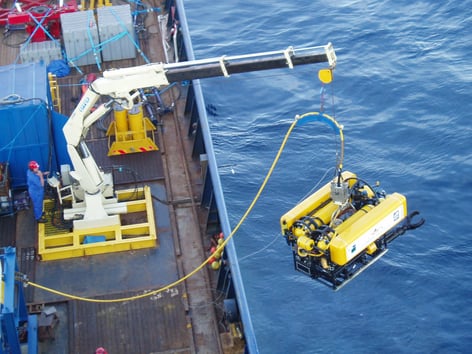
This is not entirely new, but it is becoming standard in more applications.
As ROV systems, subsea sensors, and offshore infrastructure rely more heavily on real-time data, the cable is no longer just a connection. It is part of the system architecture.
That introduces new design challenges.
Electrical efficiency, optical performance, shielding, and grounding all need to work together within the same structure. At the same time, the cable still needs to handle bending, tension, and repeated handling without compromising internal components.
The complexity is not always visible from the outside, but it is fundamental to how these cables perform in the field.
Weight and handling are getting more attention
Another shift that does not always get highlighted is the growing focus on cable weight and handling.
Heavier, overbuilt designs can meet strength requirements, but they also impact installation. They affect winch sizing, deck operations, and the overall efficiency of deployment campaigns.
For operators, that translates into time, fuel, and logistical considerations that go beyond the cable itself.
As a result, more designs are being optimized not just for strength, but for balance. Conductor sizing, armor configuration, and internal construction are being adjusted to reduce weight while maintaining mechanical performance.
These are incremental changes, but they add up in real-world operations.
Data demands are shaping design decisions
.jpg?width=397&height=238&name=iStock-2157313698%20(1).jpg) Subsea systems are carrying more data than they were even a decade ago.
Subsea systems are carrying more data than they were even a decade ago.
High-definition video, sensor networks, and remote diagnostics all depend on reliable, high-bandwidth transmission. In many applications, especially in ROV and research environments, that data is critical to operations.
This has a direct impact on cable design.
Higher fiber counts, improved optical performance, and redundancy are becoming more common. But these features have to be integrated without compromising the cable’s ability to perform mechanically.
It is not just about adding capability. It is about making sure that the capability holds up under the same physical demands that subsea cables have always faced.
Lifecycle expectations are higher—and more visible
“Next-generation” also shows up in how performance is evaluated over time.
It is no longer enough for a cable to meet specifications at installation. Operators are placing more emphasis on how systems perform years into service, especially in applications where intervention is costly or limited.
Material behavior, fatigue resistance, and long-term stability are getting more attention as a result.
This is where design decisions made early, from material selection to construction methods and validation testing, have a lasting impact.
Because in subsea environments, most failures are not immediate. They develop over time, often under repeated stress and exposure.
And when they surface, the cost of addressing them is rarely small.
What “next-generation” should really signal
In practice, “next-generation” subsea cable design is not defined by a single breakthrough.
It is the result of several shifts happening at once:
- Greater integration between power and data systems
- Increased demand for bandwidth and real-time performance
- More attention to handling, weight, and installation efficiency
- Stronger focus on lifecycle performance, not just initial specs
None of these replaces the fundamentals. Strength, durability, and reliability are still essential.
But the context around them is changing.
How Rochester Cable is responding
At Rochester Cable, these shifts show up in the kinds of subsea systems we’re designing for every day. As power, data, and mechanical demands continue to converge, cable design has to do more than meet a specification on paper. It has to reflect how the system will actually be deployed, handled, and expected to perform over time.
That is why our subsea portfolio continues to emphasize integrated electro-optical designs, application-specific construction for work-class ROVs and ocean research systems, and cable solutions tailored to the realities of offshore production and subsea operations. In each case, the goal is the same: balance strength, flexibility, bandwidth, and long-term performance in a way that supports the full system, not just the cable on its own.
“Next-generation” can mean many things in subsea. Still, the most meaningful changes tend to be practical ones: smarter integration, better application fit, and designs that account for where the industry is headed. That is the shift we are focused on at Rochester Cable, and it is where we see the most meaningful progress happening.